















Victron Energy
Victron Battery Monitor BMV-702 BLACK · Delivery time approx. 2–4 weeks
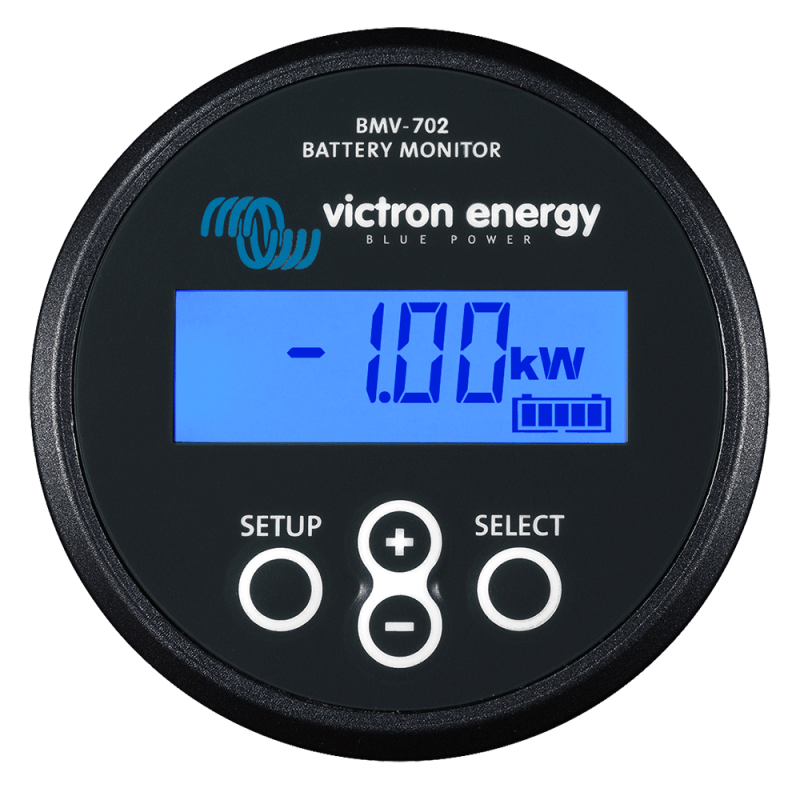
BMV-702 BLACK Battery Monitor from Victron: Reliable Battery Monitoring
Battery fuel gauge, remaining runtime indicator, and much moreThe BMV-702 is a highly accurate battery monitor.
The main function of a battery monitor is to calculate the ampere-hours consumed and the state of charge of a battery. The ampere-hours consumed are calculated by integrating the current flowing into and out of the battery.
The remaining battery capacity depends on the ampere-hours consumed, the discharge current, the temperature, and the age of the battery. Complex software algorithms are required to take all these variables into account. In addition to basic display options such as voltage, current, and ampere-hours consumed, the BMV-702 devices also display the state of charge, remaining runtime, and power consumption in watts.
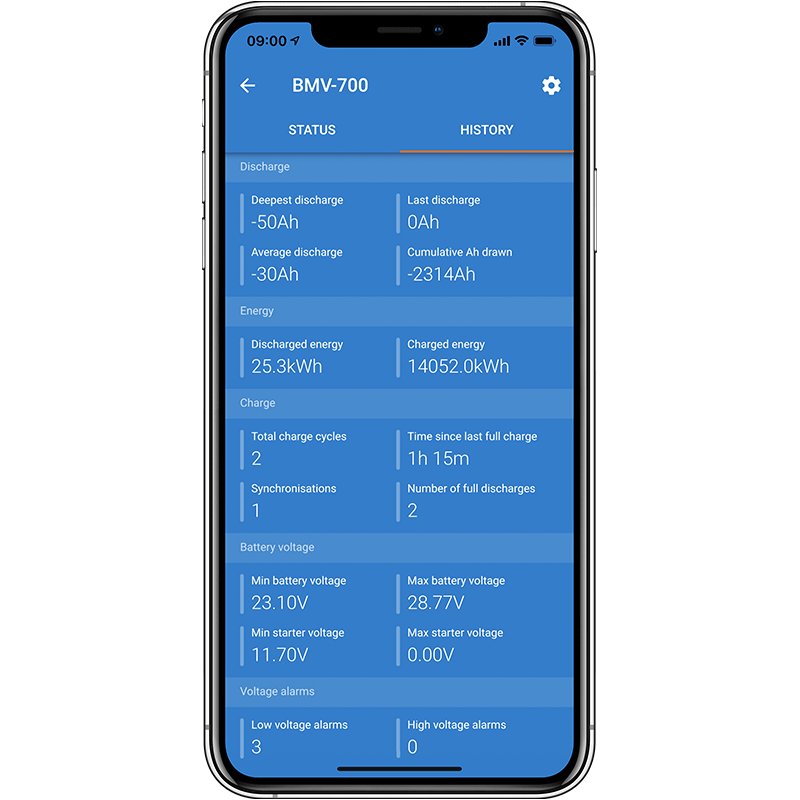
With the Bluetooth Smart Dongle, you can monitor your batteries using an Apple or Android smartphone, tablet, MacBook, or other devices.
Easy InstallationAll electrical connections are made with the PCB connector on the current shunt. The shunt is connected to the monitor via a standard RJ12 telephone cable.
Included in delivery: RJ 12 cable (10 m) and battery cable with fuse (2 m). No other components are needed. Also included are a separate front bezel for a square or round display; a safety ring for rear mounting; and screws for front mounting.
A quick installation menu and a comprehensive scroll-through setup menu assist the user when making various settings. Alternatively, a quick and easy solution can be used: download the smartphone app (Bluetooth Smart Dongle required).
Midpoint Voltage Monitoring (exclusive to the BMV 702!)This function, often used in industry to monitor large and expensive battery banks, is now available for the first time at a more affordable price, allowing any battery bank to be monitored.
A battery bank consists of a string of cells connected in series. The midpoint voltage is the voltage after half of the string. Ideally, the midpoint voltage should be exactly half of the total voltage.
However, in practice, deviations occur. These depend on numerous factors, such as different states of charge in new batteries or cells, different temperatures, internal leakage currents, capacities, and many others.
Large or increasing deviations in the midpoint voltage indicate improper battery maintenance or a faulty battery or cell. Corrective measures as a result of a midpoint voltage alarm can prevent serious damage to an expensive battery.
- Battery voltage, current, power, ampere-hours consumed, and state of charge
- Remaining runtime at current discharge rate
- Programmable visual and audible alarm
- Programmable relay to switch off non-essential loads or switch on a generator when needed.
- A 500 Amp quick-connect shunt and a connection kit are included
- VE.Direct communication port
- Stores a wide range of historical data, which can be used to evaluate usage patterns and battery condition.
- Wide input voltage range: 6.5 – 95 V
- High current measurement resolution 10 mA (0.01 A)
- Low power consumption 2.9 Ah per month (4 mA) at 12 V and 2.2 Ah per month (3 mA) at 24 V
Additional features of the BMV-702
Additional input for measuring voltage (of a second battery), temperature, or midpoint voltage, as well as associated alarm and relay settings
We continuously evaluate this product according to our MI-Eco-Score criteria.
We continuously evaluate this product according to our MI-Eco-Score criteria.
We continuously evaluate this product according to our MI-Eco-Score criteria.
We continuously evaluate this product according to our MI-Eco-Score criteria.
We continuously evaluate this product according to our MI-Eco-Score criteria.
We continuously evaluate this product according to our MI-Eco-Score criteria.
We continuously evaluate this product according to our MI-Eco-Score criteria.
We continuously evaluate this product according to our MI-Eco-Score criteria.
We continuously evaluate this product according to our MI-Eco-Score criteria.
We continuously evaluate this product according to our MI-Eco-Score criteria.
We continuously evaluate this product according to our MI-Eco-Score criteria.
We continuously evaluate this product according to our MI-Eco-Score criteria.
We continuously evaluate this product according to our MI-Eco-Score criteria.
We continuously evaluate this product according to our MI-Eco-Score criteria.
We continuously evaluate this product according to our MI-Eco-Score criteria.
We continuously evaluate this product according to our MI-Eco-Score criteria.
We continuously evaluate this product according to our MI-Eco-Score criteria.
We continuously evaluate this product according to our MI-Eco-Score criteria.
We continuously evaluate this product according to our MI-Eco-Score criteria.
We continuously evaluate this product according to our MI-Eco-Score criteria.
We continuously evaluate this product according to our MI-Eco-Score criteria.